 Add to Chrome
 Add to Firefox
 Add to Edge
Generalized Task-Driven Design of Soft Robots via Reduced-Order FEM-based Surrogate Modeling
Mar 20, 2026
Task-driven design of soft robots requires models that are physically accurate and computationally efficient, while remaining transferable across actuator designs and task scenarios. However, existing modeling approaches typically face a fundamental trade-off between physical fidelity and computational efficiency, which limits model reuse across design and task variations and constrains scalable task-driven optimization. This paper presents a unified reduced-order finite element method (FEM)-based surrogate modeling pipeline for generalized task-driven soft robot design. High-fidelity FEM simulations characterize actuator behavior at the modular level, from which compact surrogate joint models are constructed for evaluation within a pseudo-rigid body model (PRBM). A meta-model maps actuator design parameters to surrogate representations, enabling rapid instantiation across a parameterized actuator family. The resulting models are embedded into a PRBM-based simulation environment, supporting task-level simulation and optimization under realistic physical constraints. The proposed pipeline is validated through sim-to-real transfer across multiple actuator types, including bellow-type pneumatic actuators and a tendon-driven soft finger, as well as two task-driven design studies: soft gripper co-design via Reinforcement Learning (RL) and 3D actuator shape matching via evolutionary optimization. The results demonstrate high accuracy, efficiency, and reliable reuse, providing a scalable foundation for autonomous task-driven soft robot design.

HRI-SA: A Multimodal Dataset for Online Assessment of Human Situational Awareness during Remote Human-Robot Teaming
Mar 18, 2026Maintaining situational awareness (SA) is critical in human-robot teams. Yet, under high workload and dynamic conditions, operators often experience SA gaps. Automated detection of SA gaps could provide timely assistance for operators. However, conventional SA measures either disrupt task flow or cannot capture real-time fluctuations, limiting their operational utility. To the best of our knowledge, no publicly available dataset currently supports the systematic evaluation of online human SA assessment in human-robot teaming. To advance the development of online SA assessment tools, we introduce HRI-SA, a multimodal dataset from 30 participants in a realistic search-and-rescue human-robot teaming context, incorporating eye movements, pupil diameter, biosignals, user interactions, and robot data. The experimental protocol included predefined events requiring timely operator assistance, with ground truth SA latency of two types (perceptual and comprehension) systematically obtained by measuring the time between assistance need onset and resolution. We illustrate the utility of this dataset by evaluating standard machine learning models for detecting perceptual SA latencies using generic eye-tracking features and contextual features. Results show that eye-tracking features alone effectively classified perceptual SA latency (recall=88.91%, F1=67.63%) using leave-one-group-out cross-validation, with performance improved through contextual data fusion (recall=91.51%, F1=80.38%). This paper contributes the first public dataset supporting the systematic evaluation of SA throughout a human-robot teaming mission, while also demonstrating the potential of generic eye-tracking features for continuous perceptual SA latency detection in remote human-robot teaming.
Grasp Synthesis Matching From Rigid To Soft Robot Grippers Using Conditional Flow Matching
Feb 19, 2026A representation gap exists between grasp synthesis for rigid and soft grippers. Anygrasp [1] and many other grasp synthesis methods are designed for rigid parallel grippers, and adapting them to soft grippers often fails to capture their unique compliant behaviors, resulting in data-intensive and inaccurate models. To bridge this gap, this paper proposes a novel framework to map grasp poses from a rigid gripper model to a soft Fin-ray gripper. We utilize Conditional Flow Matching (CFM), a generative model, to learn this complex transformation. Our methodology includes a data collection pipeline to generate paired rigid-soft grasp poses. A U-Net autoencoder conditions the CFM model on the object's geometry from a depth image, allowing it to learn a continuous mapping from an initial Anygrasp pose to a stable Fin-ray gripper pose. We validate our approach on a 7-DOF robot, demonstrating that our CFM-generated poses achieve a higher overall success rate for seen and unseen objects (34% and 46% respectively) compared to the baseline rigid poses (6% and 25% respectively) when executed by the soft gripper. The model shows significant improvements, particularly for cylindrical (50% and 100% success for seen and unseen objects) and spherical objects (25% and 31% success for seen and unseen objects), and successfully generalizes to unseen objects. This work presents CFM as a data-efficient and effective method for transferring grasp strategies, offering a scalable methodology for other soft robotic systems.
ReefFlex: A Generative Design Framework for Soft Robotic Grasping of Organic and Fragile objects
Feb 09, 2026Climate change, invasive species and human activities are currently damaging the world's coral reefs at unprecedented rates, threatening their vast biodiversity and fisheries, and reducing coastal protection. Solving this vast challenge requires scalable coral regeneration technologies that can breed climate-resilient species and accelerate the natural regrowth processes; actions that are impeded by the absence of safe and robust tools to handle the fragile coral. We investigate ReefFlex, a generative soft finger design methodology that explores a diverse space of soft fingers to produce a set of candidates capable of safely grasping fragile and geometrically heterogeneous coral in a cluttered environment. Our key insight is encoding heterogeneous grasping into a reduced set of motion primitives, creating a simplified, tractable multi-objective optimisation problem. To evaluate the method, we design a soft robot for reef rehabilitation, which grows and manipulates coral in onshore aquaculture facilities for future reef out-planting. We demonstrate ReefFlex increases both grasp success and grasp quality (disturbance resistance, positioning accuracy) and reduces in adverse events encountered during coral manipulation compared to reference designs. ReefFlex, offers a generalisable method to design soft end-effectors for complex handling and paves a pathway towards automation in previously unachievable domains like coral handling for restoration.
RAPT: Model-Predictive Out-of-Distribution Detection and Failure Diagnosis for Sim-to-Real Humanoid Robots
Feb 02, 2026Deploying learned control policies on humanoid robots is challenging: policies that appear robust in simulation can execute confidently in out-of-distribution (OOD) states after Sim-to-Real transfer, leading to silent failures that risk hardware damage. Although anomaly detection can mitigate these failures, prior methods are often incompatible with high-rate control, poorly calibrated at the extremely low false-positive rates required for practical deployment, or operate as black boxes that provide a binary stop signal without explaining why the robot drifted from nominal behavior. We present RAPT, a lightweight, self-supervised deployment-time monitor for 50Hz humanoid control. RAPT learns a probabilistic spatio-temporal manifold of nominal execution from simulation and evaluates execution-time predictive deviation as a calibrated, per-dimension signal. This yields (i) reliable online OOD detection under strict false-positive constraints and (ii) a continuous, interpretable measure of Sim-to-Real mismatch that can be tracked over time to quantify how far deployment has drifted from training. Beyond detection, we introduce an automated post-hoc root-cause analysis pipeline that combines gradient-based temporal saliency derived from RAPT's reconstruction objective with LLM-based reasoning conditioned on saliency and joint kinematics to produce semantic failure diagnoses in a zero-shot setting. We evaluate RAPT on a Unitree G1 humanoid across four complex tasks in simulation and on physical hardware. In large-scale simulation, RAPT improves True Positive Rate (TPR) by 37% over the strongest baseline at a fixed episode-level false positive rate of 0.5%. On real-world deployments, RAPT achieves a 12.5% TPR improvement and provides actionable interpretability, reaching 75% root-cause classification accuracy across 16 real-world failures using only proprioceptive data.
SimTO: A simulation-based topology optimization framework for bespoke soft robotic grippers
Jan 27, 2026Soft robotic grippers are essential for grasping delicate, geometrically complex objects in manufacturing, healthcare and agriculture. However, existing grippers struggle to grasp feature-rich objects with high topological variability, including gears with sharp tooth profiles on automotive assembly lines, corals with fragile protrusions, or vegetables with irregular branching structures like broccoli. Unlike simple geometric primitives such as cubes or spheres, feature-rich objects lack a clear "optimal" contact surface, making them both difficult to grasp and susceptible to damage when grasped by existing gripper designs. Safe handling of such objects therefore requires specialized soft grippers whose morphology is tailored to the object's features. Topology optimization offers a promising approach for producing specialized grippers, but its utility is limited by the requirement for pre-defined load cases. For soft grippers interacting with feature-rich objects, these loads arise from hundreds of unpredictable gripper-object contact forces during grasping and are unknown a priori. To address this problem, we introduce SimTO, a framework that enables high-resolution topology optimization by automatically extracting load cases from a contact-based physics simulator, eliminating the need for manual load specification. Given an arbitrary feature-rich object, SimTO produces highly customized soft grippers with fine-grained morphological features tailored to the object geometry. Numerical results show our designs are not only highly specialized to feature-rich objects, but also generalize to unseen objects.
A Comprehensive Experimental Characterization of Mechanical Layer Jamming Systems
Nov 11, 2025Organisms in nature, such as Cephalopods and Pachyderms, exploit stiffness modulation to achieve amazing dexterity in the control of their appendages. In this paper, we explore the phenomenon of layer jamming, which is a popular stiffness modulation mechanism that provides an equivalent capability for soft robots. More specifically, we focus on mechanical layer jamming, which we realise through two-layer multi material structure with tooth-like protrusions. We identify key design parameters for mechanical layer jamming systems, including the ability to modulate stiffness, and perform a variety of comprehensive tests placing the specimens under bending and torsional loads to understand the influence of our selected design parameters (mainly tooth geometry) on the performance of the jammed structures. We note the ability of these structures to produce a peak change in stiffness of 5 times in bending and 3.2 times in torsion. We also measure the force required to separate the two jammed layers, an often ignored parameter in the study of jamming-induced stiffness change. This study aims to shed light on the principled design of mechanical layer jammed systems and guide researchers in the selection of appropriate designs for their specific application domains.
Programmable Telescopic Soft Pneumatic Actuators for Deployable and Shape Morphing Soft Robots
Nov 10, 2025Soft Robotics presents a rich canvas for free-form and continuum devices capable of exerting forces in any direction and transforming between arbitrary configurations. However, there is no current way to tractably and directly exploit the design freedom due to the curse of dimensionality. Parameterisable sets of designs offer a pathway towards tractable, modular soft robotics that appropriately harness the behavioural freeform of soft structures to create rich embodied behaviours. In this work, we present a parametrised class of soft actuators, Programmable Telescopic Soft Pneumatic Actuators (PTSPAs). PTSPAs expand axially on inflation for deployable structures and manipulation in challenging confined spaces. We introduce a parametric geometry generator to customise actuator models from high-level inputs, and explore the new design space through semi-automated experimentation and systematic exploration of key parameters. Using it we characterise the actuators' extension/bending, expansion, and stiffness and reveal clear relationships between key design parameters and performance. Finally we demonstrate the application of the actuators in a deployable soft quadruped whose legs deploy to walk, enabling automatic adaptation to confined spaces. PTSPAs present new design paradigm for deployable and shape morphing structures and wherever large length changes are required.
Scalable Multi-Objective Robot Reinforcement Learning through Gradient Conflict Resolution
Sep 18, 2025Reinforcement Learning (RL) robot controllers usually aggregate many task objectives into one scalar reward. While large-scale proximal policy optimisation (PPO) has enabled impressive results such as robust robot locomotion in the real world, many tasks still require careful reward tuning and are brittle to local optima. Tuning cost and sub-optimality grow with the number of objectives, limiting scalability. Modelling reward vectors and their trade-offs can address these issues; however, multi-objective methods remain underused in RL for robotics because of computational cost and optimisation difficulty. In this work, we investigate the conflict between gradient contributions for each objective that emerge from scalarising the task objectives. In particular, we explicitly address the conflict between task-based rewards and terms that regularise the policy towards realistic behaviour. We propose GCR-PPO, a modification to actor-critic optimisation that decomposes the actor update into objective-wise gradients using a multi-headed critic and resolves conflicts based on the objective priority. Our methodology, GCR-PPO, is evaluated on the well-known IsaacLab manipulation and locomotion benchmarks and additional multi-objective modifications on two related tasks. We show superior scalability compared to parallel PPO (p = 0.04), without significant computational overhead. We also show higher performance with more conflicting tasks. GCR-PPO improves on large-scale PPO with an average improvement of 9.5%, with high-conflict tasks observing a greater improvement. The code is available at https://github.com/humphreymunn/GCR-PPO.
A Framework for Dynamic Situational Awareness in Human Robot Teams: An Interview Study
Jan 15, 2025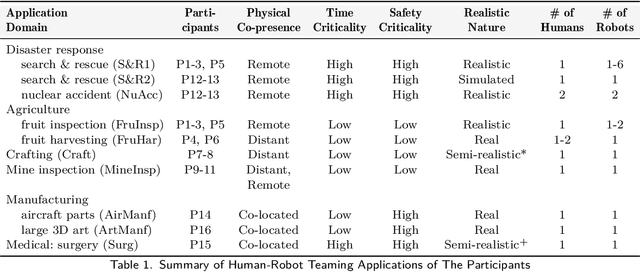

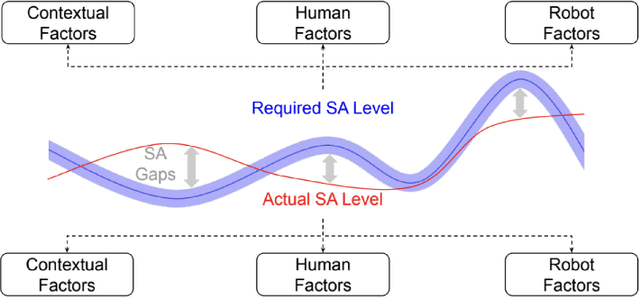

In human-robot teams, human situational awareness is the operator's conscious knowledge of the team's states, actions, plans and their environment. Appropriate human situational awareness is critical to successful human-robot collaboration. In human-robot teaming, it is often assumed that the best and required level of situational awareness is knowing everything at all times. This view is problematic, because what a human needs to know for optimal team performance varies given the dynamic environmental conditions, task context and roles and capabilities of team members. We explore this topic by interviewing 16 participants with active and repeated experience in diverse human-robot teaming applications. Based on analysis of these interviews, we derive a framework explaining the dynamic nature of required situational awareness in human-robot teaming. In addition, we identify a range of factors affecting the dynamic nature of required and actual levels of situational awareness (i.e., dynamic situational awareness), types of situational awareness inefficiencies resulting from gaps between actual and required situational awareness, and their main consequences. We also reveal various strategies, initiated by humans and robots, that assist in maintaining the required situational awareness. Our findings inform the implementation of accurate estimates of dynamic situational awareness and the design of user-adaptive human-robot interfaces. Therefore, this work contributes to the future design of more collaborative and effective human-robot teams.